
About Saxony-Anhalt
An Overview of Saxony-Anhalt
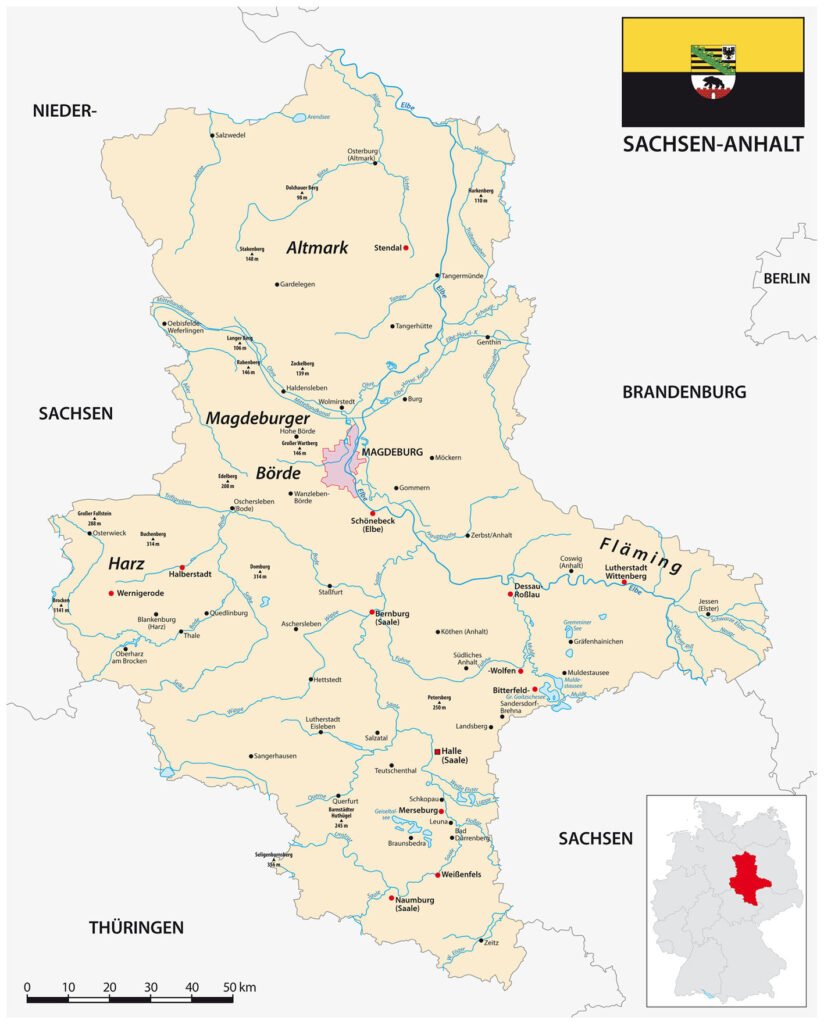
Saxony-Anhalt, a federal state situated in eastern Germany, serves as a geographical and cultural bridge between the north and the south of the country.
Bordered by the states of Lower Saxony to the northwest, Thuringia to the south, and Saxony to the east, Saxony-Anhalt occupies a strategic position that has shaped its historical and economic development. With the Elbe River flowing through its territory, the region enjoys a diverse landscape that encompasses rolling hills, dense forests, and river valleys, making it an area of both natural beauty and ecological significance.
This federal state is notable for its rich cultural heritage, which has been influenced by centuries of history, including the eras of the Holy Roman Empire and the later establishment of the German Empire. Key cities such as Magdeburg, the state capital, and Halle are not only historical centers but also vibrant urban areas showcasing Saxony-Anhalt's contributions to German art, education, and industry. The region is renowned for its UNESCO World Heritage Sites, including the fascinating town of Quedlinburg and the Dessau-Wörlitz Garden Realm, which highlight the state's architectural and artistic achievements.
In addition to its UNESCO sites, Saxony-Anhalt is home to numerous museums, festivals, and cultural events that celebrate both traditional and contemporary arts. The region's significance is further enhanced by its role in Germany’s industrial landscape, particularly in sectors like chemical production and engineering. As such, Saxony-Anhalt not only retains its historical essence but also presents opportunities for modern development and innovation.
Map of Saxony-Anhalt
A Brief History of Saxony-Anhalt
Saxony-Anhalt, located in the heart of Germany, boasts a rich and multifaceted history that has significantly impacted its cultural and societal landscape. Tracing its origins back to the early medieval period, the region served as a pivotal center for various Germanic tribes, and over the centuries, it evolved into a vital hub within the Holy Roman Empire. The establishment of the bishopric of Magdeburg in 968 marked the beginning of Saxony-Anhalt's prominence, effectively positioning it as one of the key ecclesiastical territories in medieval Europe.
The Reformation of the 16th century is another crucial chapter that shaped Saxony-Anhalt. Martin Luther, a seminal figure in this movement, initiated his revolutionary teachings in the small town of Wittenberg. This led to significant religious upheaval, with Saxony-Anhalt becoming a hotbed of Protestant thought. The region's alignment with the Lutheran faith not only influenced its spiritual landscape but also affirmed its cultural identity, which remains evident today in its historic churches and landmarks.
The 19th century ushered in the Industrial Revolution, which further transformed Saxony-Anhalt. The rise of industries such as textiles and chemicals played an instrumental role in the region's economic development, leading to urbanization and a shift in demographics. Notable figures emerged during this period, contributing to advancements in technology and social reforms. The Bauhaus movement, notably linked to the city of Dessau, also began influencing modern design and architecture, leaving an indelible mark on global artistic trends.
Throughout the 20th century, Saxony-Anhalt experienced dramatic shifts due to the effects of World Wars and the subsequent division of Germany during the Cold War. The reunification of Germany in 1990 marked a significant turning point, allowing Saxony-Anhalt to embrace its historical heritage while integrating into a modern democratic framework. This rich tapestry of events has made Saxony-Anhalt a region with a deep-rooted historical significance that continues to influence its present and future.
Climate of Saxony-Anhalt
Saxony-Anhalt is characterized by a temperate oceanic climate, which considerably influences the local lifestyle, agriculture, and tourism. The region experiences four distinct seasons, with each bringing unique weather patterns. Winters are typically cold, with temperatures often dropping below freezing, while summers are generally warm, with average highs reaching around 25°C (77°F). The transitional seasons of spring and autumn bring varying weather, including blossom and vibrant foliage, adding to the region's natural beauty.
In terms of precipitation, Saxony-Anhalt receives moderate rainfall throughout the year, with a slight increase during the summer months. This varying precipitation is crucial for agriculture, which is a significant part of the local economy. The temperate climate and fertile soils allow for diverse crop production, including grains, fruits, and vegetables. Farmers in the region can take advantage of the predictable seasonal changes, planning their planting and harvesting schedules in harmony with the climate.
The geographical position of Saxony-Anhalt also plays a vital role in shaping its climate. Located at the heart of Europe, the region is influenced by oceanic air masses from the Atlantic, leading to mild winters and temperate summers. Additionally, the varied topography, which includes hills and river valleys, can create microclimates, resulting in localized variations in temperature and precipitation. This geographical diversity enhances the appeal, making it a popular destination for tourists who seek to experience the vibrant seasonal changes.
Overall, the climate of Saxony-Anhalt significantly impacts both daily life and economic activities, making it a unique aspect of the region that contributes to its cultural identity and visitor experiences.
Demographics of Saxony-Anhalt
Saxony-Anhal is characterized by a diverse demographic structure that reflects both historical developments and contemporary trends. As of the latest statistics, the population of Saxony-Anhalt is approximately 2.2 million residents. This figure represents a gradual decline from previous decades, primarily influenced by migration patterns and the aging population. The region's demographic profile consists of various age groups, with a notable proportion of the population being over 65 years old, indicating a shift towards an older demographic.
The age distribution in Saxony-Anhalt exhibits a significant percentage of younger individuals, particularly in urban areas. Cities such as Magdeburg and Halle attract younger populations, leading to a demographic contrast between urban centers and rural regions. In contrast, many rural areas experience population decrease due to youth migration towards cities in search of better educational and employment opportunities. This urban-rural divide presents challenges for local communities in sustaining services and infrastructure.
Ethnic diversity in Saxony-Anhalt is relatively moderate compared to larger metropolitan areas. The majority of residents are of German descent; however, there has been an increase in ethnic minorities due to recent migration trends. The influx of immigrants has contributed to a more multicultural society, enhancing the local cultural landscape. This demographic change is also reflected in educational institutions and workplaces that embrace inclusivity.
Migration patterns in Saxony-Anhalt reveal both emigration and immigration trends. While some areas struggle with outmigration, leading to population decline, others have seen an increase in international residents contributing to workforce demands. Overall, Saxony-Anhalt’s demographics are continually evolving, driven by a combination of aging, migration, and urbanization, underscoring the need for policies that address these changes effectively.
Economy of Saxony-Anhalt
The economy of Saxony-Anhalt, a state situated in central Germany, has experienced significant evolution and transformation over the past few decades. Following the reunification of Germany, the region underwent considerable structural changes, impacting various sectors and the overall employment landscape. Historically rich in agriculture, manufacturing, and the service sector, Saxony-Anhalt continues to balance these industries in its quest for economic stability and growth.
Agriculture remains a vital component of the local economy, contributing to both employment and food production. The fertile plains of the region support the cultivation of cereals, potatoes, and sugar beets, as well as livestock farming. These agricultural activities not only sustain local livelihoods but also play a role in the broader supply chain of food production across Germany.
The manufacturing industry, historically the backbone of Saxony-Anhalt's economy, has undergone significant transformation since the 1990s. The state is known for its production of chemicals, machinery, and high-technology equipment. The integration of innovation in manufacturing has been a focal point for economic growth, as local companies strive to enhance competitiveness through advanced technologies. The presence of significant corporations and tailored support from institutions fosters a stimulating environment for investments in manufacturing.
In addition to agriculture and manufacturing, the service sector has expanded, becoming an increasingly critical part of the economy. The growth of tourism, healthcare, and information technology services contribute to employment and economic resilience within the state. However, Saxony-Anhalt also faces various economic challenges, including population decline, an aging workforce, and the need for modernization across industries. Addressing these challenges through strategic initiatives will be essential for securing the future economic health of Saxony-Anhalt.
Cultural Heritage and Attractions
Saxony-Anhalt boasts a profound cultural heritage that attracts visitors from around the globe. The region is home to several UNESCO World Heritage sites, including the stunning Bauhaus and its Sites in Weimar and Dessau, as well as the medieval monuments in Quedlinburg and the Dessau-Wörlitz Garden Realm. These sites not only represent significant architectural achievements but also reflect the historical narratives of the region, commemorating Saxony-Anhalt’s legacy in art and architecture.
The rich tapestry of Saxony-Anhalt's cultural attractions extends beyond its historical sites. Numerous museums can be found throughout the region, showcasing everything from historical artifacts to contemporary art. The State Museum of Prehistory in Halle, for example, houses the famous Nebra Sky Disk, a remarkable archaeological discovery that offers insight into early astronomical understanding. Furthermore, the Martin Luther sites in Wittenberg serve as monuments to the Reformation, making it an essential destination for those interested in religious history.
Festivals also play a crucial role in celebrating the cultural identity of Saxony-Anhalt. The region hosts a variety of events, such as the Wernigerode Castle Fair and the annual Quedlinburg Christmas Market, drawing both locals and tourists alike. These festivals provide an authentic experience of local traditions, showcasing regional cuisine, music, and crafts. Many towns in Saxony-Anhalt proudly preserve their customs, offering unique glimpses into life through the ages, thus enriching the visitor experience.
Visitors to Saxony-Anhalt are encouraged to explore its diverse cultural heritage and attractions. By embracing both the historical and contemporary aspects of the region, one can gain a comprehensive understanding of what makes Saxony-Anhalt an exceptional place to visit. The unique blend of UNESCO sites, vibrant museums, and lively festivals beckons travelers to immerse themselves in this fascinating cultural landscape.
Education and Research in Saxony-Anhalt
Saxony-Anhalt boasts a dynamic educational landscape that significantly contributes to its regional development and innovation. The state is home to several notable universities, including Martin Luther University Halle-Wittenberg and Otto von Guericke University Magdeburg. These institutions offer a range of programs and disciplines, attracting both domestic and international students, thereby fostering a multicultural academic environment. The presence of these universities not only enhances the educational qualifications of the local population but also promotes research and innovation, vital for the region's growth.
In addition to traditional universities, Saxony-Anhalt is known for its research institutions. The Max Planck Institute for Dynamics of Complex Technical Systems and the Fraunhofer Institute for Factory Operation and Automation are prominent examples that underscore the state’s commitment to advancing scientific and technological knowledge. These institutes are instrumental in conducting cutting-edge research that aligns with industry needs, facilitating collaboration between academia and business sectors.
Moreover, vocational training programs play a critical role in shaping the workforce of Saxony-Anhalt. These programs, often conducted in partnership with local businesses, ensure that the skills produced meet the demands of the labor market. Technical schools and vocational colleges equip students with practical experiences in various fields, enhancing employability and driving economic prosperity.
The education sector in Saxony-Anhalt is also supported by various initiatives aimed at enhancing digital literacy and innovation among students. By integrating modern technologies into the curriculum, educational institutions prepare students for the evolving job market. The concerted efforts to boost education and research are pivotal in establishing Saxony-Anhalt as a thriving knowledge region, promoting sustainable development and a competitive economy.